
A kitchen is one of the most important parts of any home. It is where meals are prepared, family members spend time together, and daily routines begin and end. Because of this, many homeowners want a kitchen that is beautiful, organized, durable, and comfortable to use.
This is where a modular kitchen can make a major difference.
But before starting a project, one important question usually comes to mind:
How much does a modular kitchen cost in India in 2026?
There is no single fixed answer. The final cost depends on the kitchen size, layout, cabinet material, shutter finish, hardware, countertop, accessories, appliances, installation, electrical work, and plumbing requirements.
A compact straight kitchen may cost much less than a large U-shaped kitchen with premium finishes and built-in appliances. Similarly, a basic laminate kitchen will have a different price from a luxury kitchen with acrylic shutters, quartz countertops, soft-close hardware, and customized storage.
In this guide, we will explain modular kitchen costs in simple terms. You will learn about different layouts, materials, budget ranges, cost-saving ideas, quotation details, and important questions to ask before beginning your project.
“A beautiful kitchen is not only about appearance; it is about making everyday life easier.”
What Is a Modular Kitchen?
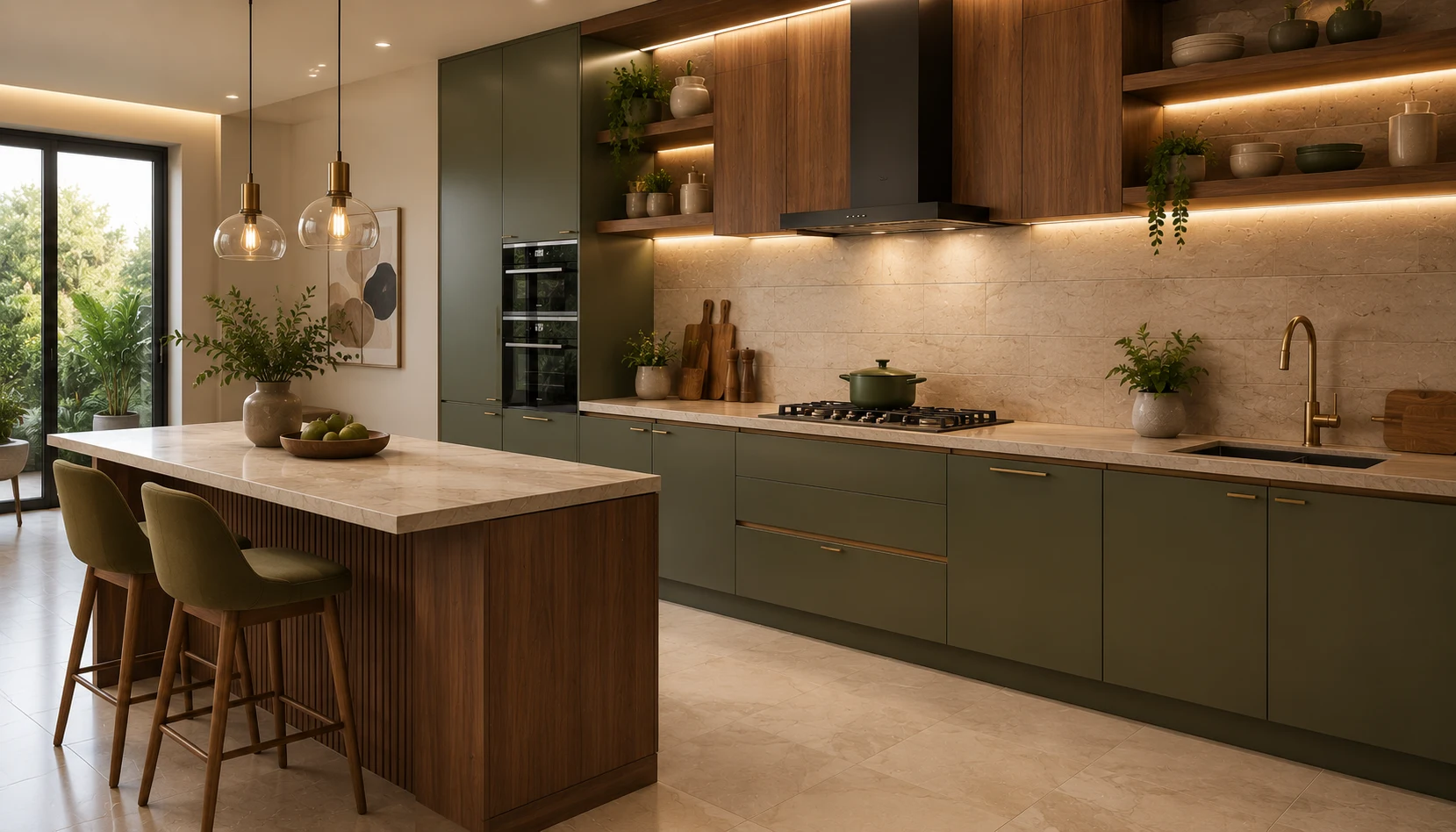
A modular kitchen is made using separate cabinet units or modules that are designed, manufactured, and installed together. These modules may include base cabinets, wall cabinets, drawers, tall units, corner storage, sink units, pantry units, appliance units, and open shelves.
The biggest advantage of a modular kitchen is that it can be planned according to the available space. Instead of placing random cabinets in the room, a designer studies the kitchen layout, appliance positions, storage requirements, movement, lighting, and plumbing points.
A well-designed modular kitchen should provide three important things:
- Good storage
- Easy movement
- Comfortable daily use
It should also match the overall style of your home.
For example, a small apartment may benefit from a straight or L-shaped kitchen, while a larger home may have enough space for a parallel, U-shaped, or island kitchen.
Modular kitchens are also easier to customize. You can select the cabinet material, shutter finish, handles, countertop, accessories, and storage systems according to your budget and lifestyle.
However, customization can increase the cost. Therefore, it is important to decide your priorities before finalizing the design.
A practical kitchen does not need to include every available accessory. It should include the features that you will actually use.
Modular Kitchen Cost in India in 2026
In 2026, the cost of a modular kitchen in India may broadly range from ₹1.5 lakh to ₹8 lakh or more. The final price depends on the size, layout, materials, hardware, accessories, countertop, appliances, and installation work.
Here is a general budget guide:
| Kitchen Type | Approximate Budget |
|---|---|
| Small Basic Kitchen | ₹1.5 lakh to ₹2.5 lakh |
| Small to Medium Kitchen | ₹2 lakh to ₹3.5 lakh |
| Medium Modular Kitchen | ₹3 lakh to ₹5 lakh |
| Large Premium Kitchen | ₹5 lakh to ₹8 lakh+ |
| Luxury Kitchen | ₹8 lakh+ |
These figures are only planning estimates. The actual quotation may vary depending on the city, brand, material quality, design complexity, site conditions, and labour charges.
A basic kitchen may include standard cabinets, laminate shutters, essential drawers, a regular countertop, and limited accessories. A premium kitchen may include acrylic or PU finishes, high-quality plywood or HDHMR, soft-close hardware, tall units, corner systems, built-in appliances, quartz countertops, and designer lighting.
When comparing prices, do not look only at the total amount. Check what is included in the package.
One company may quote ₹3 lakh for cabinets only, while another may include the countertop, sink, accessories, installation, and taxes in the same amount.
“The cheapest quotation is not always the most affordable choice in the long run.”
Main Factors That Affect Modular Kitchen Cost
Several factors influence the final cost of a modular kitchen. The most important ones are the kitchen size, layout, cabinet material, shutter finish, hardware, countertop, accessories, appliances, and installation.
The size determines how many cabinets and how much countertop material will be required. The layout affects the number of corners, cabinet units, and storage systems. A straight kitchen is usually simpler than a U-shaped or island kitchen.
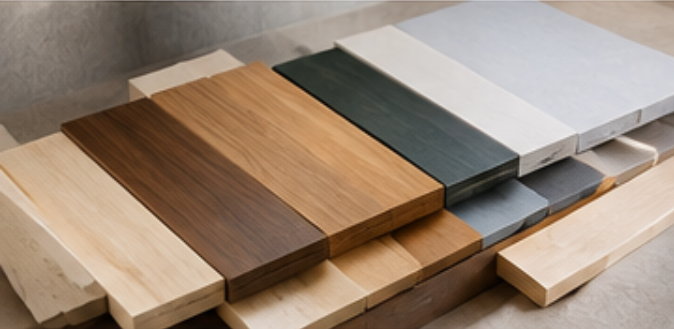
The cabinet material also makes a major difference. Plywood, MDF, HDHMR, and particle board have different prices and performance levels. The shutter finish can further increase or reduce the budget. Laminate is generally practical and affordable, while acrylic, PU, veneer, and glass may cost more.
Hardware is another important factor. Hinges, drawer channels, lift-up systems, handles, and corner mechanisms are used every day. Better hardware usually improves comfort and durability.
Countertop material, sink design, lighting, electrical changes, plumbing work, delivery, and installation also contribute to the total cost.
Before starting the project, prepare a complete list of requirements. This will help you understand where your money is going.
A clear budget should include:
- Cabinets
- Shutters
- Hardware
- Countertop
- Sink
- Accessories
- Appliances
- Installation
- Electrical work
- Plumbing work
- Delivery
- Taxes, where applicable
Kitchen Layout and Its Effect on Price
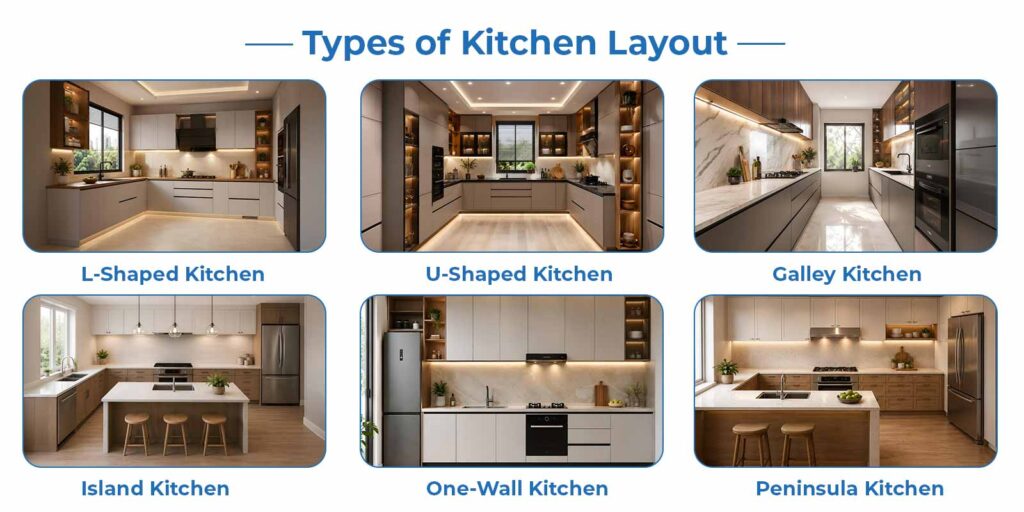
The layout of the kitchen has a direct effect on the cost. Common layouts include straight, L-shaped, parallel, U-shaped, and island kitchens.
A straight kitchen uses one wall and is usually suitable for compact homes. It requires fewer cabinets, less countertop material, and simpler installation.
An L-shaped kitchen uses two connected walls. It offers better storage and movement and is one of the most popular layouts in Indian homes. However, the corner area may require special storage solutions.
A parallel kitchen has cabinets on two opposite walls. It provides excellent storage but requires enough space for comfortable movement between both sides.
A U-shaped kitchen uses three walls and offers a large working area. Since it requires more cabinets, countertop, hardware, and accessories, it usually costs more.
An island kitchen includes a separate counter in the centre. It can provide additional storage, workspace, seating, and visual appeal. However, it requires sufficient space around the island. Electrical or plumbing work may also be needed.
| Layout | Suitable For | General Cost Level |
|---|---|---|
| Straight | Small apartments | Low to medium |
| L-Shaped | Small and medium kitchens | Medium |
| Parallel | Long and wider kitchens | Medium to high |
| U-Shaped | Medium and large kitchens | High |
| Island | Large open kitchens | High to premium |
The best layout is not always the most expensive one. It should match your space, cooking habits, storage needs, and movement requirements.
Cabinet Materials: Plywood, MDF, and HDHMR
The material used inside the cabinets has a major effect on the durability and price of the kitchen.
Plywood
Plywood is made by joining thin layers of wood together. Good-quality plywood is strong and commonly used in kitchen cabinets. It can perform well in areas where moisture may be present, but the grade and quality must be checked carefully.
MDF
MDF, or Medium Density Fibreboard, is made from processed wood fibres. It provides a smooth surface and can be suitable for certain cabinet applications and finishes. It is often considered a budget-friendly option, but it should be used carefully in moisture-prone areas.
HDHMR
HDHMR, or High Density High Moisture Resistance board, is designed to offer better moisture resistance than some regular boards. It is used in many interior and kitchen projects. However, the quality of the actual product is more important than the name alone.
Particle Board
Particle board is generally more affordable but may not offer the same strength or moisture resistance as better-quality plywood or HDHMR.
There is no single material that is best for every kitchen. The right choice depends on your budget, usage, moisture exposure, cabinet location, finish, and expected lifespan.
Ask your designer for the exact material name, thickness, grade, and warranty before approving the design.
“Choose materials according to performance, not only according to appearance or price.”
Shutter Finishes and Their Cost Impact
The shutter finish is the visible outer surface of the kitchen cabinets. It plays an important role in the appearance, maintenance, and cost of the kitchen.
Laminate
Laminate is one of the most practical choices for Indian kitchens. It is available in many colours, textures, patterns, and price ranges. It is easy to maintain and suitable for everyday use.
Acrylic
Acrylic provides a smooth and glossy appearance. It can make a kitchen look modern and bright. However, glossy surfaces may show fingerprints, dust, and scratches more easily.
Membrane
Membrane finishes can create a smooth appearance and are available in modern and classic designs. Their price depends on the quality, pattern, and cabinet construction.
PU Finish
PU finish is often selected for premium interiors. It provides a rich and smooth appearance but usually costs more because of the finishing process.
Veneer
Veneer gives a natural wood-like appearance. It can create a warm and elegant kitchen but may require more maintenance than laminate.
Glass
Glass shutters can be used as accent elements in wall cabinets or display units. They can increase the overall cost depending on the type of glass and frame.
When selecting a finish, consider more than colour. Think about cleaning, fingerprints, scratches, moisture, sunlight, and long-term maintenance.
A practical laminate kitchen can look attractive and perform well without exceeding the budget.
Hardware and Kitchen Accessories
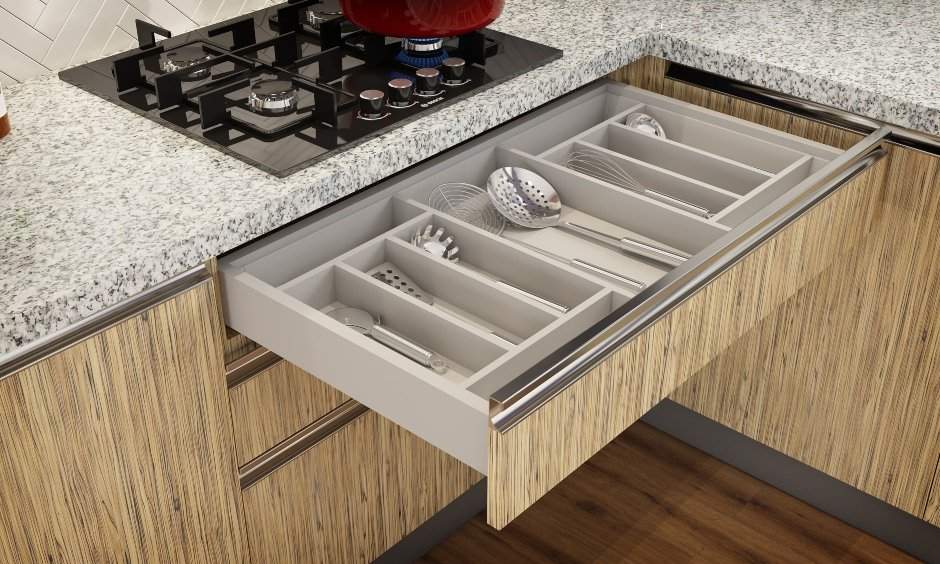
Hardware includes hinges, drawer channels, handles, lift-up mechanisms, corner systems, and pull-out units. These components may not be highly visible, but they affect the daily experience of using the kitchen.
Soft-close hinges and drawer channels allow doors and drawers to close smoothly and quietly. Good-quality hardware can also improve alignment, durability, and safety.
Popular kitchen accessories include:
- Bottle pull-outs
- Spice racks
- Cutlery trays
- Tandem drawers
- Magic corner units
- Tall pantry units
- Under-sink storage
- Waste bins
- Plate racks
- Appliance lift systems
Accessories can increase the cost, but they can also improve organization. The important thing is to choose them according to your actual needs.
For example, a spice pull-out may be useful for someone who cooks regularly with many spices. A tall pantry unit may be valuable for a family that stores large quantities of groceries. A magic corner may help use a difficult corner area.
However, installing every accessory can make the kitchen expensive without adding real value.
If your budget is limited, prioritize frequently used hardware and storage systems. It is often better to choose practical shutters with reliable hardware than expensive shutters with poor-quality fittings.
Countertop, Sink, and Backsplash Cost
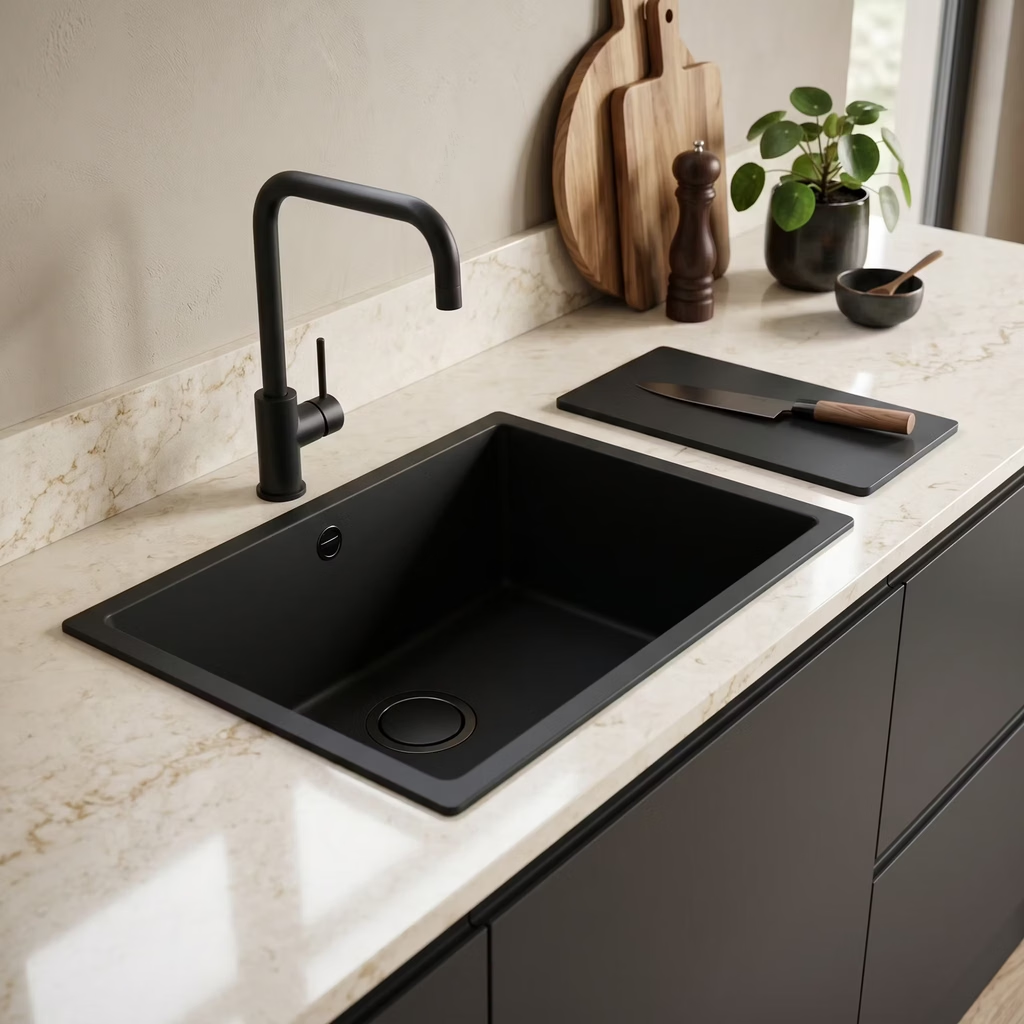
The countertop is one of the most important parts of a modular kitchen. It must be durable, easy to clean, and suitable for regular cooking.
Common countertop options include:
- Granite
- Quartz
- Marble
- Engineered stone
- Other solid surfaces
Granite is widely used in Indian homes because it is available in many colours and can be durable. Quartz offers a modern appearance and a wide range of design options. Marble provides a premium natural look but may require more care.
The cost depends on the material, thickness, size, edge profile, cut-outs, and installation.
The sink should also be included in the budget. Sinks are available in different sizes, shapes, materials, bowl configurations, and installation styles.
Before selecting a sink, consider:
- Countertop space
- Sink depth
- Number of bowls
- Cleaning requirements
- Family size
- Installation type
- Faucet position
The backsplash is another element that can affect the cost. It may be made using tiles, glass, stone, quartz, or other materials.
A good countertop and sink should be selected for practical use, not only for appearance.
Appliances, Electrical Work, and Plumbing
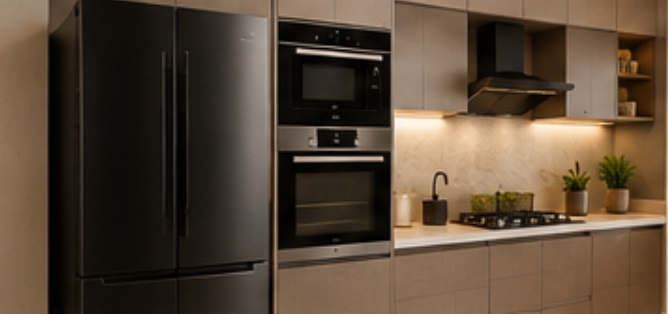
Kitchen appliances can significantly increase the total project cost. Common appliances include chimneys, hobs, built-in ovens, microwaves, refrigerators, dishwashers, and water purifiers.
Some interior packages include only cabinets, while others may include the countertop, sink, chimney, hob, and selected accessories. Appliances are often charged separately.
Always ask what is included in the quotation.
Electrical work may be required for:
- Chimney
- Hob
- Oven
- Microwave
- Refrigerator
- Dishwasher
- Water purifier
- Under-cabinet lighting
Plumbing work may be needed for the sink, water purifier, dishwasher, or other water connections.
These points should be planned before cabinet manufacturing begins. If electrical or plumbing points need to be moved after installation, the work may become inconvenient and more expensive.
A professional designer should prepare an appliance layout and service-point plan. This helps ensure that every appliance has the correct space, power connection, ventilation, and water supply.
Do not assume that electrical and plumbing work is included in the modular kitchen price. Ask for a separate breakdown if necessary.
Modular Kitchen Cost by Budget Level
A modular kitchen can be planned according to different budget levels.
Budget Kitchen: ₹1.5 Lakh to ₹2.5 Lakh
A budget kitchen usually includes practical cabinet materials, laminate shutters, basic hardware, essential drawers, a standard countertop, and limited accessories.
This option is suitable for homeowners who want a clean and functional kitchen without adding premium features.
Mid-Range Kitchen: ₹2.5 Lakh to ₹5 Lakh
A mid-range kitchen provides more flexibility. It may include better cabinet materials, improved finishes, soft-close hardware, additional drawers, useful accessories, better countertops, and more storage.
This range often offers a good balance between appearance, comfort, and durability.
Premium Kitchen: ₹5 Lakh and Above
A premium kitchen may include high-quality materials, acrylic or PU finishes, premium hardware, tall units, large storage systems, built-in appliances, island counters, designer lighting, and quartz or other premium countertops.
The final price depends heavily on the specifications and customization.
| Budget Level | Common Features |
|---|---|
| Budget | Laminate, basic hardware, essential storage |
| Mid-Range | Better materials, soft-close hardware, useful accessories |
| Premium | Premium finishes, advanced storage, built-in appliances, designer details |
The best budget is the one that supports your actual needs without creating unnecessary financial pressure.
How to Save Money on a Modular Kitchen

You do not need to spend the maximum amount to create a good modular kitchen. Smart planning can help you control the budget.
Start by choosing a simple layout. A straight or basic L-shaped kitchen may be more affordable than a complex U-shaped or island kitchen.
Select practical finishes. A good-quality laminate can provide an attractive appearance and easy maintenance at a reasonable price.
Focus on useful storage. Do not install accessories simply because they are popular. Choose pull-outs, drawers, pantry units, and corner systems according to your cooking habits.
Compare materials carefully. Ask about price, strength, moisture resistance, maintenance, and expected lifespan.
Spend more on important hardware. Hinges and drawer channels are used every day, so reliable hardware can provide better long-term value.
Plan electrical and plumbing points in advance. Last-minute changes can increase labour costs.
You can also control the budget by selecting standard cabinet sizes, reducing unnecessary decorative elements, and comparing detailed quotations from different designers.
“Good design is not about adding more features; it is about choosing the right features.”
Common Mistakes Homeowners Should Avoid
One common mistake is choosing a kitchen only because it looks attractive in a photograph. A design may look beautiful online but may not suit your space, cooking habits, storage needs, or appliance sizes.
Another mistake is not checking the exact cabinet material. Do not accept only general terms such as “premium board” or “waterproof material.” Ask for the exact product, grade, thickness, and warranty.
Ignoring hardware is also a major mistake. Poor-quality hinges and drawer channels can create problems after regular use.
Many homeowners also fail to check what is included in the quotation. One company may include only cabinets, while another may include the countertop, sink, accessories, installation, and taxes.
Spending too much on appearance while ignoring functionality is another common problem. A kitchen should have comfortable movement, sufficient storage, proper lighting, and convenient appliance placement.
Do not forget ventilation. A chimney, window, or proper airflow can improve the kitchen environment.
Finally, avoid making major changes after manufacturing begins. Late changes can increase cost and delay the project.
A successful kitchen project depends on clear planning, accurate measurements, transparent communication, and realistic expectations.
What Should a Modular Kitchen Quotation Include?
A detailed quotation should clearly explain every item included in the project. This makes it easier to compare different designers and avoid unexpected expenses.
The quotation should ideally mention:
- Kitchen measurements
- Cabinet material
- Cabinet thickness
- Shutter finish
- Hardware type or brand
- Number of drawers
- Countertop material
- Sink details
- Accessories
- Appliance units
- Installation charges
- Delivery charges
- Electrical work
- Plumbing work
- Taxes
- Warranty
- Project timeline
- Payment schedule
Ask whether the quotation includes dismantling, civil work, wall preparation, backsplash installation, lighting, and final cleaning.
You should also ask about exclusions. Sometimes items such as appliances, electrical changes, plumbing, gas pipeline work, or chimney installation are not included.
A clear quotation protects both the homeowner and the designer. It reduces confusion and helps you understand the actual project cost.
Before signing, compare quotations based on specifications rather than only the final amount.
A lower quote may use thinner boards, basic hardware, fewer accessories, or exclude important services.
How to Choose the Right Modular Kitchen Designer
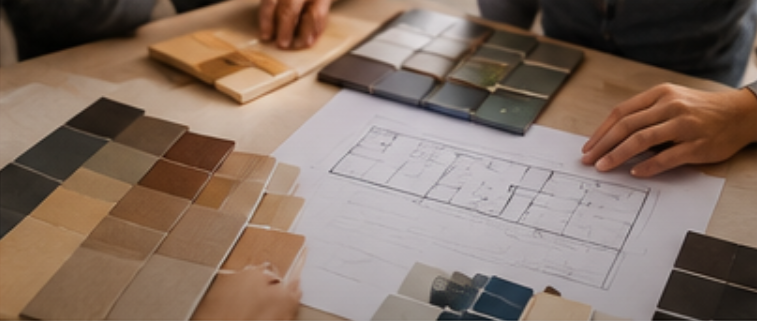
Choosing the right designer is as important as choosing the material. A good designer should understand your space, budget, lifestyle, storage needs, and design preferences.
Look for a professional who:
- Listens carefully to your requirements
- Explains materials clearly
- Provides a detailed quotation
- Shows previous work
- Gives realistic timelines
- Communicates regularly
- Offers design revisions
- Provides installation support
- Explains warranty terms
- Offers after-sales service
Do not choose a company only because it offers the lowest price. A kitchen is used every day for many years, so quality, planning, and service matter.
Ask to see material samples before finalizing the design. Check the finish, colour, texture, hardware movement, and cabinet construction.
You should also understand the payment schedule. Avoid making the full payment before the work is completed unless the agreement clearly explains the terms.
A professional designer should also provide proper measurements and a detailed layout showing cabinet positions, appliance locations, electrical points, plumbing points, and storage systems.
At M27 Interiors, the goal is to create kitchens that are attractive, practical, comfortable, and suitable for everyday living.
Final Thoughts and Frequently Asked Questions
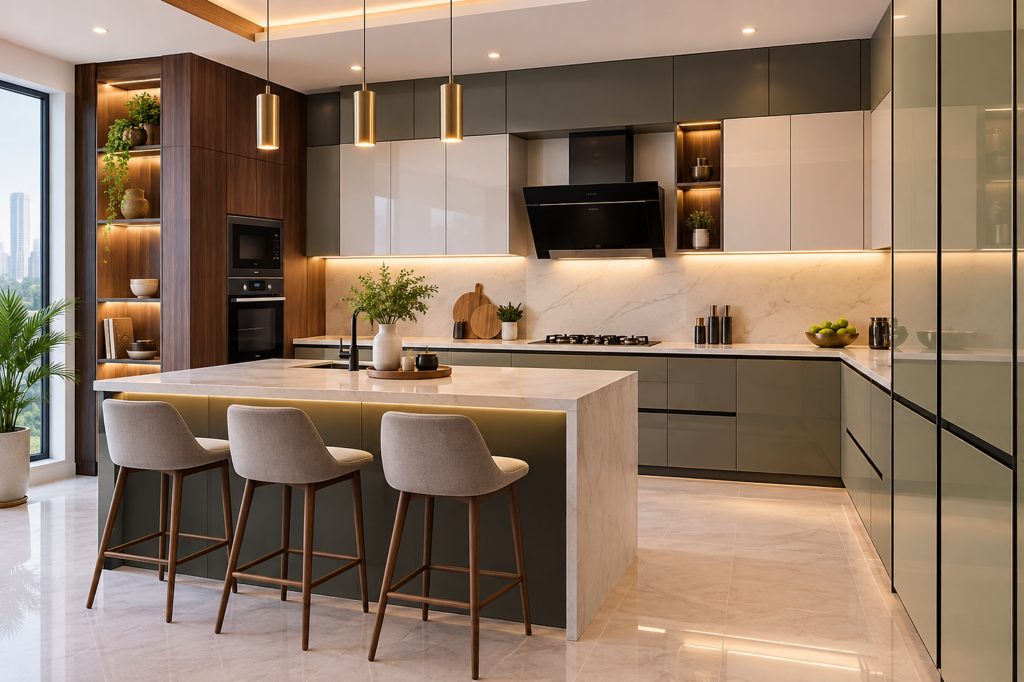
The cost of a modular kitchen in India in 2026 can range from approximately ₹1.5 lakh for a basic compact kitchen to ₹3 lakh–₹5 lakh for a medium kitchen, while premium and luxury kitchens may cost ₹5 lakh to ₹8 lakh or more.
The final price depends on the kitchen size, layout, cabinet material, shutter finish, hardware, countertop, accessories, appliances, installation, electrical work, and plumbing.
The best approach is not to ask only:
“How can I get the cheapest modular kitchen?”
Instead, ask:
“How can I get the best kitchen for my space, lifestyle, and budget?”
Start by deciding your budget. Understand your space. Choose a suitable layout. Compare materials. Select useful storage. Pay attention to hardware. Ask for a clear quotation and work with a reliable interior professional.
Frequently Asked Questions
1. What is the average cost of a modular kitchen in India in 2026?
A modular kitchen may broadly cost between ₹1.5 lakh and ₹8 lakh or more, depending on size, layout, materials, hardware, accessories, countertop, and installation.
2. How much does a small modular kitchen cost?
A small basic kitchen may start around ₹1.5 lakh. A better-equipped small kitchen may cost ₹2 lakh to ₹3 lakh or more.
3. Which modular kitchen layout is usually the most affordable?
A simple straight kitchen is generally one of the more budget-friendly layouts because it uses one wall and requires fewer cabinets.
4. Is an L-shaped kitchen expensive?
An L-shaped kitchen can range from approximately ₹2 lakh to ₹4 lakh or more, depending on size, materials, hardware, and accessories.
5. Which material is best for a modular kitchen?
Plywood, MDF, HDHMR, and other materials can be suitable for different applications. The right choice depends on budget, moisture exposure, usage, quality, and location.
6. Are appliances included in modular kitchen prices?
Not always. Chimneys, hobs, ovens, microwaves, refrigerators, and dishwashers may be charged separately.
7. Does the modular kitchen price include the countertop?
It depends on the package. Always confirm the countertop material, thickness, edge design, and installation details.
8. How can I reduce modular kitchen costs?
Choose a simple layout, select practical finishes, avoid unnecessary accessories, compare materials, and spend more on important hardware.
9. How long does a modular kitchen take to complete?
The timeline depends on design approval, manufacturing, site preparation, delivery, installation, countertop work, and service connections. Your designer should provide a realistic schedule.
10. Is a modular kitchen suitable for a small home?
Yes. Modular kitchens can make excellent use of limited space through vertical storage, drawers, corner units, and carefully planned appliance placement.
11. Should I choose a glossy or matte finish?
Glossy finishes can make a kitchen look bright and modern, while matte finishes offer a softer appearance and may hide fingerprints better.
12. Are kitchen accessories necessary?
Accessories are useful when they solve a real storage problem. Choose them according to your cooking habits and daily requirements.
13. Is a modular kitchen worth the investment?
A well-planned modular kitchen can improve storage, organization, appearance, maintenance, and daily comfort.
14. What should I check before finalizing the kitchen?
Check the material, grade, finish, hardware, countertop, accessories, measurements, installation, timeline, warranty, payment schedule, and complete quotation.
15. Where can I get help with modular kitchen planning?
You can contact M27 Interiors to discuss your kitchen space, design preferences, storage needs, budget, and complete interior requirements.